Monday, November 1, 2010

Reaction to tonight's class


Lets go back to the beginning.
A new take on Smartboards
I actually walked away from tonight presentation of the Smartboard fairly excited. It seems like a massively simplified Flash mixed with Powerpoint. Right now with my limited experience with the program I feel it will be best used as a review tool for my students, currently I would like my lecture and information sections of my teacher to be bolstered with podcast, Imovie, and the rare usage of Powerpoint.

There are two glaring problems I see so far with the Notebook program. The first being a almost nonexistent grid layout (a page split in quadrants is hardly a grid). How can we properly align items on the page and respect the almighty grid when it only runs one line on the Y axis and one line on the X? I suppose if it had a ruler that would help the anemic grid system, but that's nowhere to be seen as well, guess I will just have to guess where my picas are.

I don't want to berate the program to much because I really have not had any time in the driver's seat yet, and I'm actually pretty hopeful for the potential it holds. I am very worried about the design flaws it carries with it, but I will just have to work around those, I'm sure over the next few years they will resolve it anyway. I truly feel Smartboards will be used extensively in anticipatory sets and wrap-ups in my classroom.

Interactive Whiteboards


A short review of the "article":
Interactive White Boards in 1:1 Learning Environments


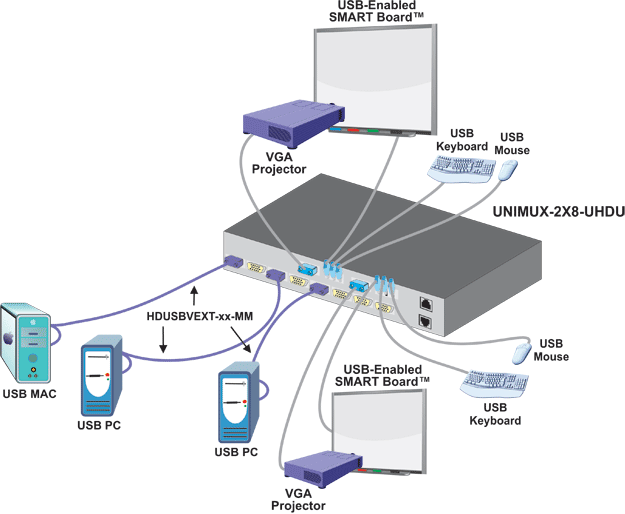
The author really needed to acclimate the reader to what an "interactive white board" is and what is does. At points the article mentions the device is "highly visual and engaging for today’s tech-savvy student", I feel in order to fully appreciate the full potential of the technology the instructor must also be "tech-savvy". A simple diagram of the whiteboard's peripherals and means of connecting them would have cleared up paragraphs of mind numbing confusion and anxiety over the devices true form and function! I provided just such a sample here:


So assuming I totally understand the ins and outs of the interactive whiteboard (which I did not until I read the wiki on it), I can finally begin to learn about how the device can interact with students and facilitate learning. There is no question that this device can help a classroom become interactive, the question however needs to be asked "do I need my classroom to be more interactive". We always talk about interactivity, but how many have stopped to think if it's necessary across the board. For art students; collaboration is not always the way to go. Solo projects are the best way for a student to practice their newly discovered techniques and hone their talents.

I appreciate the authors need to include a section on balance, but their stance on the subject is obvious and unbalanced due the fact the article is nothing more than a ten page lifeless promotional brochure. The limited exposure I have had with an interactive whiteboard has not been extensive, so I am hardly an expert on their reliability, but I would say they work properly about half of the time. For me, that reliability level is simply not high enough when you consider a sheet of velum and a few 2B pencils have a nearly 100 percent success rate.

Here is a link to some other criticism against the interactive whiteboards.

Sunday, October 31, 2010

Chuck Close


Most of Close’s work is based on a grid as an underlying basis for the representation of an image. He is the grid master, and the basis for the unit plan I am writing up this week. Some of his work is currently on display at the VMFA, if you have a chance to check it out I highly recommend it!

Gridding is a simple but surprisingly versatile structure that provides the means for “a creative process that could be interrupted repeatedly without damaging the final product, in which the segmented structure was never intended to be disguised.” None of Close’s images are created digitally or photo-mechanically.

Close’s paintings are labor intensive and highly time consuming, and his prints are even more so. While a painting can occupy him for many months, it is not unusual for one print to take upward of two years to complete. Close has complete respect for, and trust in, the technical processes and the collaboration with master printers essential to the creation of his prints. The creative process is as important to Close as the finished product. “Process and collaboration” are two words that are required in any conversation about Close’s prints.

Chuck Close specializes in photorealism, but this genre of art does not define him. He is also very well known for his work with mosaic like paintings like the one's seen in the video clip below:

Saturday, October 30, 2010

Fortune Cookies


Fortune Cookies…. I don’t like them very much. Every time you order Cantonese food they throw in a handful of these bland mass produced after meal obligations. I don’t even want to consider them an extension of the noble line of desserts. I know I’m fairly alone in my anti-fortune cookie mentality, and that’s why I want to put my hostility towards the cookie aside to develop a lesson plan based on the printed fortune inside the cookie.

The idea was brought to my attention by Ms. Masterson at Hermitage High School while I was observing some art classes a few weeks ago. She was talking about upcoming project she was introducing to her higher level art classes and this one really stuck out to me. She gave each student a fortune cookie, and then with the fortune they pulled they must create a work of art based upon it. They have to have a strong narrative and illustrate the words used in the fortune as clearly as possible.

I loved the idea, and I will have to try it out for myself. The problem with the project is how open it is. The art 1 and 2 student needs a lot more guidance than the higher level students, I’m honestly not sure if I will have many opportunities to work with the art 3-5 students much during my student teaching. I’m not saying all the art 1 and 2 students are less apt, but they usually need to be taught the fundamentals of art, the principles, and the meaning of art before they can create meaningful representations of concepts and ideas.

If I find myself with lower level art classes, I just might try to sneak this in there for them at the end of my stay as a student teacher. No one likes drawing fruit bowls, cloth, and old instruments anyway. I think this will be a great way for the students to truly encapsulate imagery based on an abstract concept (some of those fortune cookies really don’t make any sense).

Interesting.... fortune cookies are Japanese.